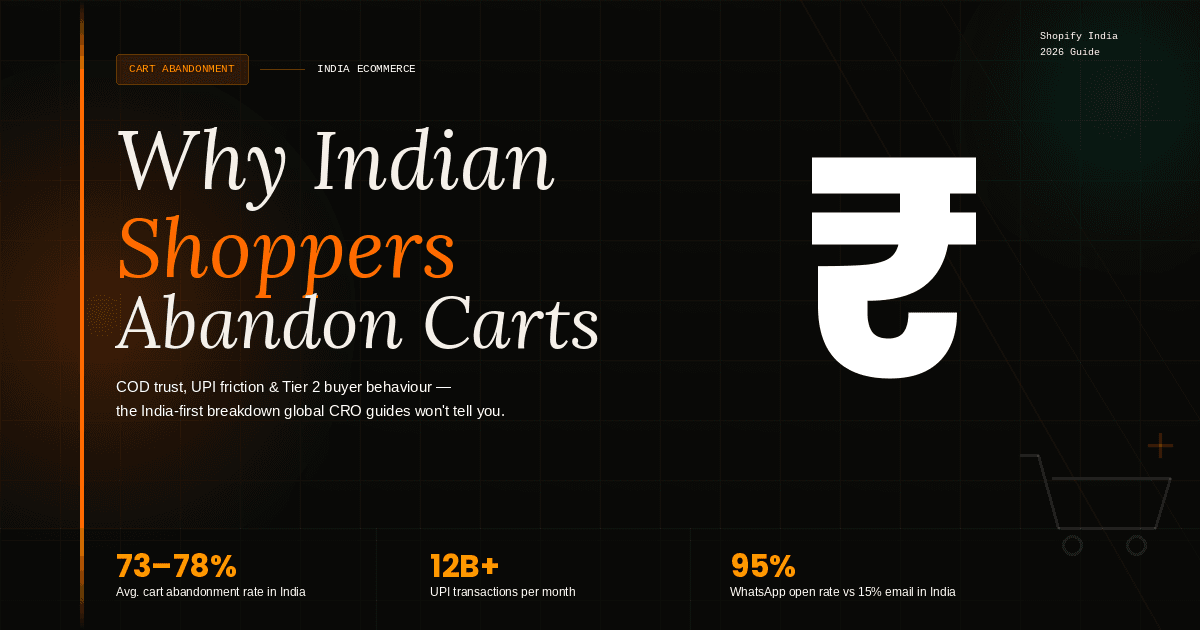
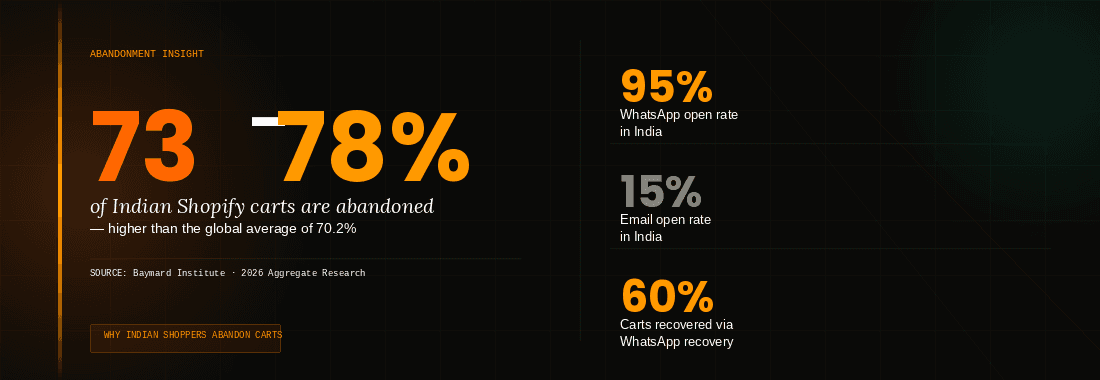
73–78% of Indian Shopify carts are abandoned - and the reasons have nothing to do with your pricing. If your cart abandonment rate stubbornly refuses to budge despite checkout tweaks and retargeting campaigns, here's the uncomfortable truth: the advice you're following was written for someone else.
The global average cart abandonment rate in 2026 sits at 70.2%, according to Baymard Institute's aggregated research across 50 studies. Indian Shopify stores consistently clock higher and the gap isn't random. Why Indian shoppers abandon carts is a trust, payments, and infrastructure problem, not a checkout design problem. Understanding that distinction is where the fix begins.
The COD Dependency Isn't Going Away In India - So Stop Fighting It
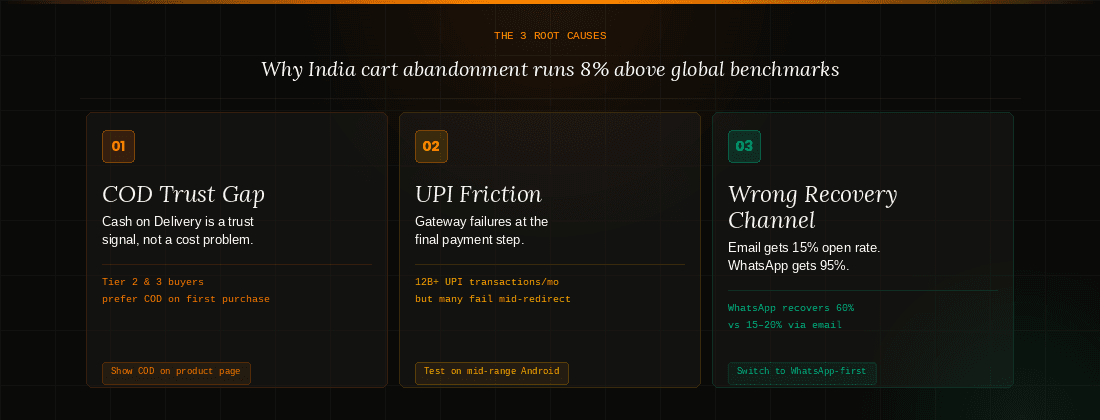
Cash on Delivery is treated as a legacy inconvenience by most D2C founders. In reality, it is a primary trust signal — especially for first-time buyers outside metro cities.
When a shopper in Kanpur or Coimbatore lands on your Shopify store for the first time, they carry no brand familiarity, no prior transaction history with you, and limited confidence in digital dispute resolution. COD removes every one of those objections in a single step. According to Razorpay's India Payments Report, COD still accounts for a significant share of D2C order volume in Tier 2 and Tier 3 cities, with first-time buyers disproportionately preferring it.
When you remove COD to cut operational costs — or add a COD handling fee at checkout without disclosing it upfront — you're not trimming a cost line. You're removing the trust mechanism that converts hesitant first-time buyers.
Fix it: Display COD availability prominently on the product page itself — not buried at the payment step. If you must charge a COD handling fee, state it at the product level. Transparency at the right moment keeps the cart; a surprise at checkout kills it.
UPI Friction Is Real and Measurable
UPI now processes over 12 billion transactions every month in India, making it the dominant digital payment channel in the country. Yet many Shopify stores implement it poorly — slow gateway redirects, OTP loops that break on mid-range Android devices, and confirmation pages that fail to load after payment approval.
Unlike card payments, UPI has zero tolerance for friction. A customer who opens their UPI app, approves the request, and returns to a broken confirmation page does not get a second chance. That session is gone. The Shopify cart abandonment India problem, in many cases, is less about purchase intent and more about technical failure at the final payment step.
Fix it: Test your UPI checkout flow on a mid-range Android device on a 4G connection — not on a desktop or a flagship phone. Check gateway redirect timing, confirm the success page loads within 3 seconds of payment approval, and verify your payment gateway (Razorpay, Cashfree, or PayU) has auto-retry enabled for failed UPI collect requests. Fix this before running your next paid campaign.
Tier 2 and Tier 3 Buyers Operate on Different Assumptions
India's ecommerce growth story in 2026 is being written in smaller cities. But these buyers arrive with expectations shaped by Meesho, Flipkart, and Amazon — platforms that have trained them to expect free shipping, COD availability, and explicit delivery timelines as table stakes, not features.
When a D2C Shopify store fails to surface any of these upfront, the cart abandonment rate India 2026 data reflects it immediately. Research from Indian ecommerce studies consistently identifies unexpected shipping costs and late-disclosed COD charges as the top abandonment triggers for Tier 2 and Tier 3 shoppers — a pattern significantly more pronounced than among metro buyers who are more familiar with D2C purchasing norms.
Fix it: Add a shipping cost estimator and delivery timeline on the product page. If you offer free shipping above a threshold, show that threshold before the buyer reaches the cart. These aren't nice-to-haves for smaller-city buyers — they're the information they need before they commit.
The Recovery Channel Problem
Global cart recovery playbooks default to a three-email sequence. In India, email open rates hover between 15–20%. WhatsApp, by contrast, delivers open rates above 95% among Indian smartphone users, according to Meta's India engagement data.
A recovery sequence that brings back 8–12% of abandoned carts in the US may recover less than half that in India — not because the emails are poorly written, but because they're not being opened. Shopify merchants using WhatsApp-first recovery through tools like Bitespeed or HillTeck report cart recovery rates as high as 60%, compared to 15–20% through email alone.
Fix it: Set up a WhatsApp abandoned cart sequence as your primary recovery channel. A three-message flow works well — a reminder at 1 hour, a soft nudge with social proof at 24 hours, and a time-limited offer at 48 hours. Keep email as a secondary layer, not your lead channel.
Frequently Asked Questions
Q: What is a good cart abandonment rate for Shopify stores in India?
A: Below 65% is considered strong for Indian D2C stores. The national average runs between 73–78%, so there is meaningful room to improve through payment localisation and checkout transparency alone.
Q: Is COD still relevant for Shopify stores targeting metro buyers?
A: Less so for repeat metro buyers, but still relevant for first-time purchases in any city. Offering COD with a clear disclosure of any handling fees is lower risk than removing it entirely.
Q: Which WhatsApp tool works best for Shopify cart recovery in India?
A: Bitespeed and HillTeck are the two most commonly used by Indian Shopify merchants. Both integrate natively with Shopify and support automated message sequencing via the WhatsApp Business API.
What This Means for Your Store
Shopify cart abandonment India is a solvable problem — but only once you stop applying global solutions to local buyer behaviour.
Show COD availability on product pages. Fix your UPI gateway before your next ad spend. State shipping costs and delivery timelines where Tier 2 buyers can find them early. And rebuild your cart recovery around WhatsApp as the primary channel, with email as a backup.
The gap between Indian and global abandonment benchmarks isn't inevitable. It is a structural problem with a structural fix. The brands closing that gap in 2026 are the ones engineering their checkout for India — not for a global template that was never built with Indian buyers in mind.
Sources: Baymard Institute Cart Abandonment Research (2026 aggregate); NPCI UPI Transaction Volume Data (2025–26); Razorpay India Payments Report; Meta WhatsApp India Engagement Data; HillTeck Shopify India Merchant Benchmarks.
About author
Sayanti K
Head of Content
Subscribe to our newsletter
Sign up to get the most recent blog articles in your email every week.